Posts

Showing posts with the label Tim Woodcock

Someday at Christmas

Image
Tim Woodcock writes... Though I had heard the Stevie Wonder song “Someday at Christmas” before, I didn’t really pay it much attention until I heard it on “the Uncle Lanny mix” about 20 years. Let me explain. Uncle Lanny is my wife’s uncle who lives in the Boston area; 20 years back, he gave us a CD, burned from his computer, of Christmas music. In my immediate family, it’s become a tradition of many years standing to start Advent, the countdown to Christmas, by listening to this CD (although nowadays the music is organized as a Spotify playlist).   It starts with Nat King Cole singing about chestnuts roasting over an open fire, then Elvis Presley is experiencing a Blue Christmas – standard stuff but it’s a tastefully curated mix of Christmas hits. The song that always catches my ear, the song that always makes me catch my breath, is Stevie Wonder’s version of “Some Day at Christmas.” The song begins this way: Someday at Christmas men won't be boys Playing with bombs...

Amid the rubble...

Image
Tim Woodcock writes… This is a very striking photo that encountered recently. I received it embedded in an email from an organization called Embrace the Middle East. While its meaning might seem plain, there was no caption, so I put it aside for a few days, assuming that it was a tragic candid photo of a church nativity scene, somewhere in the Palestine/Israel area, in which the church had been badly damaged. But there is more to the story than that... Several days later, it occurred to me that with the wonders of technology, I could do a “reverse image search” online to find out what exactly the photo was portraying. Many companies offer this feature; Google’s search worked best for me. It’s an image from Bethlehem that began to be circulated about 10 days ago. It does not show a recently bombed church at all but is an artistically created creche in the Evangelical Lutheran Christmas Church in Bethlehem. To reflect the warzone around them, the church create the seasonal decoratio...

Thoughts on the Kingdom and the "Kin-dom"

Image
 Tim Woodcock writes:  It has been only been ten days since King Charles III was crowned. As a Brit, people have asked me about it multiple times since then. Do I like Charles? Am I a fan of the royal family? Does the pomp and circumstance of the occasion make me glow with pride? My thoughts and feelings on this are so complex and contradictory that trying to write a coherent response seems impossible. So instead here are some impressionist bullet points, firstly on the British royal family, and secondly on the idea of kingship plays in the modern church.          The verb is “crowned,” people! It is not as I heard it on a reputable news source, NPR, recently – “coronated.”           King Charles – not very inspiring, is he? I suppose you can say he will grow into the role and it’s simply impossible to please everyone as a monarch, especially as a monarch in the modern world. Queen Elizabeth II’s stature as a dignified, fai...

Help, Thanks, Wow

Image
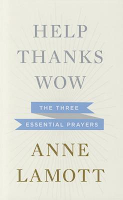
Tim Woodcock writes: Back in the summer, I read Annie Lamott’s Help, Thanks, Wow – Three Essential Prayers , mentioned in a previous blog post . While I appreciated certain passages in this 100-page book in it but wasn’t sold it on it as a whole. Before returning it to the library, I made a photocopy of the section about giving thanks, thinking I might be more in the mood for it at another time. In this Thanksgiving week, I revisited it and indeed there was more waiting for me, when I dug into the book for a second time. Lamott’s great gift is her constant swerve to avoid conventional religious language and in doing so, she makes things appear fresh. She writes: You may in fact be wondering what I even mean when I use the word “prayer”… Let’s not get bogged down on whom or what we pray to. Let’s say prayer is communication from our hearts to the great mystery, or Goodness; to the animating energy of love we are sometimes bold enough to believe in, to something unimaginably big, and ...

Private prayer, public prayer

Image
Tim Woodcock writes:  There was a very interesting guest essay in the New York Times by Anne Lamott headlined “I Don’t Want to See a High School Football Coach Praying at the 50-Yard Line” responding to the recent Supreme Court Case. Hopefully you can read it here , but that depends on whether you have subscription and/or how many other NY Times articles you’d read this month: Lamott doesn’t get too caught up in the specifics of the Kennedy v. Bremerton School District court case , in which a good deal of showboating and posturing in the media somewhat disguised the real question at hand of whether a sports coach in Washington State public school was inappropriately using religion to exercise his power and influence over his players. Lamott’s strategy is to sidestep the news story almost entirely and instead critique it by cataloguing the small private prayers that punctuate her daily life. And of course, being Lamott, she writes in an idiosyncratic and entertaining styl...

The Wonder of Widgets - an exploration of Working Genius

Image
Tim Woodcock writes: At recent church retreat for session members, we explored in depth the Working Genius model, which previously been presented to us by Travis. It is partly a personality test and partly a tool for analyzing productivity, developed by Patrick Lencioni, a consultant for businesses and non-profits. If you’ve taken a Myers-Briggs test or something comparable before, the gist of the questionnaire would not be unfamiliar to you, but its focus is primarily on how people approach complex tasks and work in groups. Patrick Lencioni I was, to be frank, a little dubious to start with: it sounded like voguish corporate speak, a needlessly novel set of labels for a familiar set of concepts. The use of the boastful-sounding word “genius” rubbed me the wrong way initially and still does a little. Nonetheless, each session member plus Travis took the assessment prior to the retreat and when we discussed our questionnaire results as a group, almost everyone said it captured somethi...

Poetry: "A Doorway into Thanks"

Image
  Tim Woodcock writes: With National Poetry Month coming to an end, it’s time to share a poem by Mary Oliver that I had put aside and earmarked a few weeks back. Coincidentally, with Earth Day Sunday in mind, Mike Willock, had also sent me a reflection by Oliver about her relationship to nature, which I will incorporate into the second half of this blog post. I came across Mary Oliver's poem "Praying" a couple of months ago on a Monday morning. Why do know it was a Monday morning? Because at the school where I work there is a tradition, which dates back about 15 years, of beginning Monday's assemblies with a “poem of the week.” Usually the poem is one selected and read by a teacher, but sometimes it’s by a student; it is also a platform for students to share their own poems, if they have won awarded in local contests, which happens with some frequency. It’s lovely moment of settling in and refocusing as the school week begins. Even during the COVID-inflected turbul...

"Walking matches amidst so much gasoline"

Tim Woodcock writes: To return to the theme of the previous blog post about “ Poems of hope and resilience ,” I was struck by the power of Francisco X. Alarcon’s “ L.A. Story .” The context that gives rise to that poem is the Rodney King protests, referred not by name but simply by the date – April 1992 - that is attached to the poem. But the poem reads almost as well in the context of Ukraine or any other situation of high volatility. The poem is not a complex one. It paints a bleak, dystopian landscape, followed by this beautiful image: o god show us the way lead us   spare us  from ever turning into walking    matches amidst so much gasoline    

Is this the place for which our fathers sighed?

Image
Tim Woodcock writes: Last week Nancy Quigley offered a poem called “What is Hope?” That prompted me to dig around in the Poetry Foundation’s themed collections of poems, anticipating there would be a section of other poems about hope. There was indeed, although it’s actually labeled “ Poems of Hope and Resilience .” It’s well worth a look. Some of the poems are very well known. For instance, Emily Dickinson’s Poem No. 314, with the line “’Hope’ is the thing with feathers” and Maya Angelou’s widely quoted and inspirational “And Still I Rise.” Among the 50+ poems there are some poems that are – by my lights – incomprehensible or willfully obscure but there’s far greater number of gems, some of which I thought I’d share in an attempt to answer the question, “What is Hope?” In this blog post I’m going to focus on one poem only, but I plan to return to the theme later on highlighting a couple more poems. The poem that initially caught my eye was the astonishingly powerful “ Lift Every V...

Hark!

Image
Tim Woodcock writes: The carol “Hark! The Herald Angels Sing” stirs up very specific memories in me and, perhaps more than any other piece of music, it has the ability to transport me elsewhere. No matter where I am when I hear it, I imagine myself to be in a Methodist chapel in Ketton, a village in England, where my mom’s family is from and where we would typically spend Christmas when I was a child. “Hark! The herald-angels sing / ‘Glory to the newborn king.’” My mom’s voice, my grandma’s voice (recognizably the same timbre yet older), my grandad – a farmer whose hands are a little too large for the keys on the organ – vigorously bashing out the tune. A small crowd singing with great gusto. This is absolutely a chapel not a church, a building that holds no more than 30 people, a good portion of whom I am related to, one way or the other. But beyond that idiosyncratic association for me, there’s something more universal at play. The rising notes of “Join the triumph of the skies...

Reflections from "the dear green place"

Image
Tim Woodcock writes: As the dust settles on the recent COP26 climate summit in Glasgow, it is clear that this was not landmark event that many where hoping for. The Glasgow Climate Pact nudged humanity in the right direction, but it’s hard to characterize it as anything other than “too little, too late.” Sadly the talks in Glasgow will not earn the city a place in the history books as the location of game-changing agreements, as Rio and Paris had before it. I have a special affection for Glasgow, nicknamed “the dear green place,” having lived there for six years (studying at the University of Glasgow for four years and then living there a couple of years beyond that; it’s where I met my wife; and we still have a number of friends either in the city or nearby). Beyond our academic classes, the circles that Katy and I moved in involved university chaplaincy groups, the Quaker meeting, and various activist groups, and recently I spent an enjoyable evening trawling through the news cove...

"Deliver us from evil" - using a high-flying robe

Image
During the Aug. 13 outdoor service in Tower Grove Park, Pastor Travis preached and led a discussion about the closing phrase in the Lord’s Prayer, “deliver us from evil.” A key part of the discussion focused on how we envision evil. Do we chiefly see evil as the systems and forces that shape our actions, something akin to the “principalities and powers” that Paul writes about his letter to the Ephesians? Or is it more personalized, a specific adversary, “the evil one,” sometimes characterized as the devil or Satan? Both these are commonplace interpretations and the tension between the two has its roots in the translations favored by Western theology (systems) and the Eastern theology (a specific adversary). In the same week as I encountered this fascinating insight, I also cam across a wonderful folktale from the Buddhist tradition, which also helps to illuminate the phrase “deliver us from evil.” It gave me a entirely fresh way to think about the battle between good and evil. Some b...

The Lord's Prayer from multiple angles

Image
Tim Woodcock writes: As a complement to Pastor Travis’s sermon series on the Lord’s Prayer, I’ve been listening to a short series of reflections that similarly approaches the prayer, forensically and in sequence. It is part of a radio series called simply “The Essay,” something my wife pointed me toward, which was broadcast originally on BBC Radio 3 and is now available online. None of the commentators are approaching the Lord’s Prayer from within the framework of orthodox Christianity and it is all the richer for that. Each one is about 15 minutes in length. Among my favorites are: - The literary and playful approach of novelist, Ali Smith who, in a transporting Scottish accent, focuses on the phrase “art in heaven” - with art operating as a noun rather than an archaic verb. - Rabbi Julia Neuberger who looks at the phrase “give us our daily bread,” comparing it to the prayers of the Jewish people that Jesus would have been familiar with, as well discussing the role of bread wit...

Stopping for a red light

Image
Tim Woodcock writes: I’ve been working my way through Thich Nhat Hanh ’s wonderful little book How to Connect. It’s what I’ve come to think of as a “strong black coffee book” – something that needs to be taken slowly because it's a little too powerful to appreciate quickly.  Having just taken a road trip to Michigan and back, doing far more driving than ordinarily do in daily life, I was greatly struck by his reflection “Stopping for a red light,” perhaps in part because it echoes some of what Vickie wrote in her June 8 blog post, “Tickets, Speed Limits and Prayer Life.” On this drive, I was also struck by the reality that you’ve got to embrace the place you are in right now – whether it’s grinding urban traffic around Chicago during a rainstorm or the rolling countryside of Illinois and Indiana as the sun comes out. To give this reflection a little more context, the previous entry in How to Connect mentions the use of bells in both the Buddhist and Christian traditions. He ...

Let the light shine in

Image
  Tim Woodcock writes: One of the things I miss most about conventional, in-person church is the stained glass windows at 2 nd Pres. Yes, the people, the music, the sermons, too. All that can be experienced in a modified form online. But not spending time among the glow of the stained glass has affected me more acutely than I would have guessed. During the last two Sundays I found myself in the sanctuary for the first time in more than a year, hanging out on the sidelines rather than fully participating in the service, because Freya was doing a “Minute for Mission” one week and Katy was the liturgist the following week. Knowing that I would be at loose end, I had brought a sketchpad with me and spent some time communing with the images on the east side of the sanctuary (see below). While the significance of 2PC’s windows can recounted, as it is on the church’s website , here I’m only trying to get down some impressionistic feelings about them. Some  idiosyncratic highligh...

Mindfulness and art - an exact analogy

Image
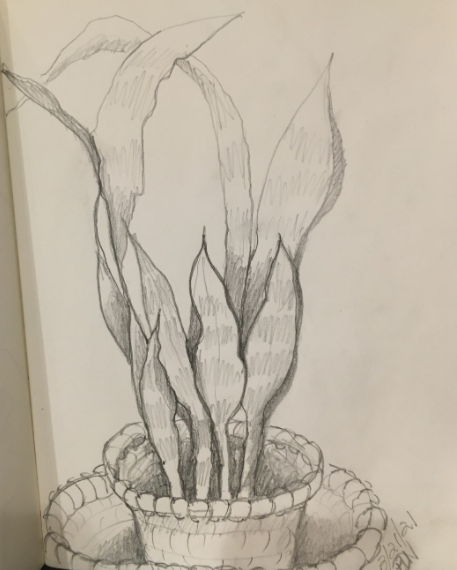
  Tim Woodcock writes: On Sunday, Lori and Doug Dowd led a Christian Forum session on mindfulness and art. Lori began with a mindful meditation focused on the breath and awareness. Doug then offered a short talk on drawing as a way to understand the world, proposing that the practice of mindfulness is analogous to the relaxed-yet-attentive state of mind one experiences when making art based on observation. He then challenged us to take part in a low-stakes art exercise: Find an ordinary object – a plant, a household item – and to observe its structure carefully before beginning to draw. He also encouraged us to enjoy the sounds and tactile feeling of a no. 2 pencil moving across a sheet of paper.  Here are some of the results:

A sign of the covenant

Image
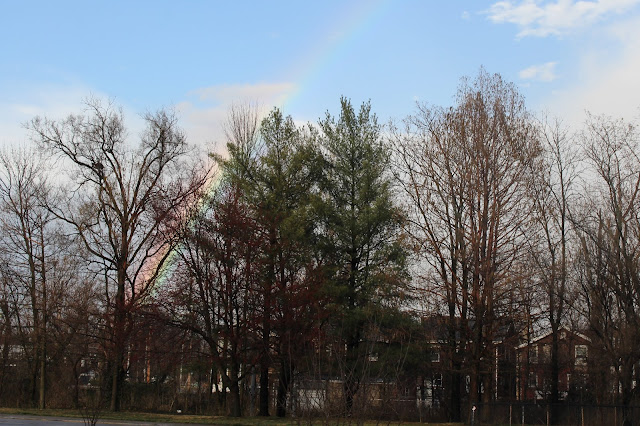
And God said, “This is the sign of the covenant I am making between me and you and every living creature with you, a covenant for all generations to come: I have set my rainbow in the clouds, and it will be the sign of the covenant between me and the earth. Whenever I bring clouds over the earth and the rainbow appears in the clouds, I will remember my covenant between me and you and all living creatures of every kind.”  (Genesis 9:12-15) Photo taken from our front yard yesterday afternoon after a day of heavy rain (Tim Woodcock)

Jesus and the hair-splitters

Image
  Tim Woodcock writes: With the bad weather this week, I found myself with a snow day followed by virtual learning day (meaning a teach-from-home day) and the chance to catch up on various neglected projects, including this blog. One of the pleasures of recent days has been getting into a series of online Scrabble games with Steve, a friend from high school, who now lives in largely COVID-free New Zealand. This led me to pick up a book I bought years ago called Word Freak by Stafan Fatis. It’s an incredibly readable look at the subculture of hardcore Scrabble players, some of whom can make decent money playing; however, it is not especially robust scene and players cannot go fully professional in the sense that a poker player or chess player can. Don’t worry: This blog post will connect to faith … I’ll get there eventually … One paragraph late in the book jumped out at me, describing Danny, a top-rated teenage player and an Orthodox Jew. Tournaments ordinarily happen at the...

An oldie but a goodie

Tim Woodcock writes: It’s an oldie but a goodie. Here is Thomas Hardy’s poem “The Darkling Thrush,” which was written to mark not just the end of the year but also the end of the century (the 1800s): it’s an accumulation of darkness, counteracted by a glimmer of hope at the end. I remember first being introduced to it in high school but I hadn’t seen enough of life to really appreciate it back then. The Darkling Thrush by Thomas Hardy   I leant upon a coppice gate       When Frost was spectre-grey, And Winter's dregs made desolate       The weakening eye of day. The tangled bine-stems scored the sky       Like strings of broken lyres, And all mankind that haunted nigh       Had sought their household fires.   The land's sharp features seemed to be       The Century's corpse outleant, His crypt the c...

Labels

Show more