Posts

Speak, Lord. Your servant is listening

Image
Mike Willock writes: At Second Church earlier this month the preaching text came from 1 Samuel 3, the call of Samuel. It’s a good story: The boy Samuel is serving in the house of the Lord under the old priest Eli at a time when the word of the Lord is rare in the land of Israel. When the lamp of God had not yet gone out, the Lord calls Samuel by name. Samuel runs to Eli, who says, “I did not call you. Go lie down.” When the call comes a third time, Eli realizes God is calling Samuel and tells Samuel to respond, “Speak, Lord . Your servant is listening.” “Speak, Lord . Your servant is listening”. Just six words, but they 1) confirm the relationship between God and Samuel, 2) affirm with conviction that God is still speaking, and 3) that Samuel is ready and willing and waiting to receive and do the word of God. As reformed Presbyterians we know that God still speaks to those who have ears to hear by the power of Holy Spirit, and that God calls us to live out God’s word in love among...

Poetry: Refreshes the Parts Other Words Cannot Reach

Image
It’s all poetry all the time at Second. This Sunday and the following Sunday, Ann Wilson will lead a discussion about poetry in a popular Christian Forum discussion before church that has taken place several times over the years – but each time with a different lens and a new set of poems. And if you’ve not seen it already, please take a look at Mike Willock’s beautiful reflection written in National Poetry Month about poems that he has found especially meaningful over the years, published on Second’s blog a couple of weeks ago. While “Poetry Sunday” is not something that is exists on any liturgical calendar, Second dubbed last Sunday’s story as its “Poetry Sunday” with the entirety of the service restructured to link sentiments from ancient Jewish scriptures to a huge variety of poems -   some very well known, some less so; some contemporary, some more traditional; all worth rereading beyond the service itself. The booklet can be found here . The service, coordinated by Kenda...

Meditations on Mortality

Image
Mike Willock writes: I love poetry – I always have. In this poetry month at Second, three poems come to mind – all of them old, like me. As aches and pains come and go each day and my mobility decreases, I recall “The One Hoss Shay” (1858) by Oliver Wendell Holmes. The poem is much too long to print here, but the gist is that the Deacon built the shay for the Parson in 1755 so it wouldn’t break down. It had no weak spot – each part was just as strong as the rest. He found the strongest oak and lancewood and ash and whitewood and elm and steel and leather to build it. In 1800 it was good as new and so it stayed until November 1, 1855 when it began to show traces of age. While the Parson was on the way to the meeting house that Sunday morning working on the fifth point of his sermon text he found himself sitting on the ground behind the horse with the shay in bits and pieces all around him.  …It went to pieces all at once, All at once, and nothing first, Just as bubbles d...

How Then Shall We Live?

A poem by Ellie Stock , appropriate for the Easter season, Earth Day and National Poetry Month in April. The poem will be included in the liturgy at Second as part of one of the upcoming services this month.     HOW THEN SHALL WE LIVE?   What do we call What calls from the deeps, that pulses through stars and quickens heart’s beat, that surges through waves and cleanses with fire, emerges from dust and breathes soul’s desire? What do we name What mocks human pride, that bends the Tree of Life, sustaining being’s tide?   How do we greet What calls to our deeps, that lasers vulnerabilities and loves us into being, that mourns lost illusions and leaves us defenseless, transforms the present moment and awakens all senses? How do we embrace What eternalizes finitude, that opens wide portals, flooding tears of gratitude?   How do we know What calls us to decide, that gives no guarantee and provides no place to hide, that beckons all...

"A God-bathed world"

Image
 A shout out to Kendal Ackerman who each week in Lent has been placing one or two framed posters of paintings by Van Gogh in the sanctuary, accompanied by devotional writing to tease out the connections between Van Gogh’s artistic vision of the world and the season of Lent. This Sunday – Easter Sunday – the culminating image was “The Raising of Lazarus.” Others images on display include “The Starry Night,” “Worn Out/At Eternity’s Gate” and “Still Life with Bible.” This quote on the leaflet to do with “The Starry Night” particularly caught my eye: “[Van Gogh’s] paintings reveal a more biblical vision of reality – one in which heaven and earth intersect to form what Dallas Willard called a ‘God-bathed world.’ We occupy a cosmos filled with God’s presence the way liquid fills a sponge.” (Quote from author and podcaster Skye Jethani) All of the write ups coordinated by Kendal can be found here .

A Spruced Up Entrance

Image
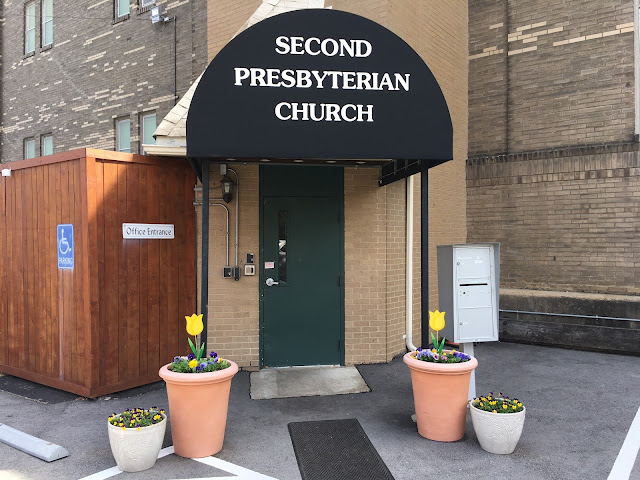
  Janet Hill works to make the church inviting and beautiful.  (Photo by Mike Willock)

Signs of Spring

Image
  A photo from Mike Willock with a note: “At the entrance to the Memorial Garden at the church. A lovely offering.” I’m sure by the time anyone is at church later in the week or next Sunday, there will be even more “lovely offerings.” Tim Woodcock writes: Over the weekend, we drove from St. Louis down to northern Arkansas for a short Spring Break trip. In the three-and-half-hour drive, we saw the familiar signs of early spring that you might expect – the pink blossoms of magnolia trees blossoming in Tower Grove Park and whites of Bradford pear trees, lining the many roads, both major and minor, when all the other trees appeared to be still dormant. Given the long drive and the sheer number of Bradford pears, we noticed an interesting phenomenon – given it’s so early, many trees were actually only half in bloom, prodigiously blooming on their south-facing sides, while still looking quite wintry on their north side. And an even more marked phenomenon in our springtime journey (wh...

Someday at Christmas

Image
Tim Woodcock writes... Though I had heard the Stevie Wonder song “Someday at Christmas” before, I didn’t really pay it much attention until I heard it on “the Uncle Lanny mix” about 20 years. Let me explain. Uncle Lanny is my wife’s uncle who lives in the Boston area; 20 years back, he gave us a CD, burned from his computer, of Christmas music. In my immediate family, it’s become a tradition of many years standing to start Advent, the countdown to Christmas, by listening to this CD (although nowadays the music is organized as a Spotify playlist).   It starts with Nat King Cole singing about chestnuts roasting over an open fire, then Elvis Presley is experiencing a Blue Christmas – standard stuff but it’s a tastefully curated mix of Christmas hits. The song that always catches my ear, the song that always makes me catch my breath, is Stevie Wonder’s version of “Some Day at Christmas.” The song begins this way: Someday at Christmas men won't be boys Playing with bombs...

Amid the rubble...

Image
Tim Woodcock writes… This is a very striking photo that encountered recently. I received it embedded in an email from an organization called Embrace the Middle East. While its meaning might seem plain, there was no caption, so I put it aside for a few days, assuming that it was a tragic candid photo of a church nativity scene, somewhere in the Palestine/Israel area, in which the church had been badly damaged. But there is more to the story than that... Several days later, it occurred to me that with the wonders of technology, I could do a “reverse image search” online to find out what exactly the photo was portraying. Many companies offer this feature; Google’s search worked best for me. It’s an image from Bethlehem that began to be circulated about 10 days ago. It does not show a recently bombed church at all but is an artistically created creche in the Evangelical Lutheran Christmas Church in Bethlehem. To reflect the warzone around them, the church create the seasonal decoratio...

From the rising of the sun to its setting ...

Image
"From the rising of the sun to its setting, the name of the Lord is to be praised" - Psalm 113:3 Sunrise photo contributed by Mike Willock 

Fall colors at Second Pres

Image
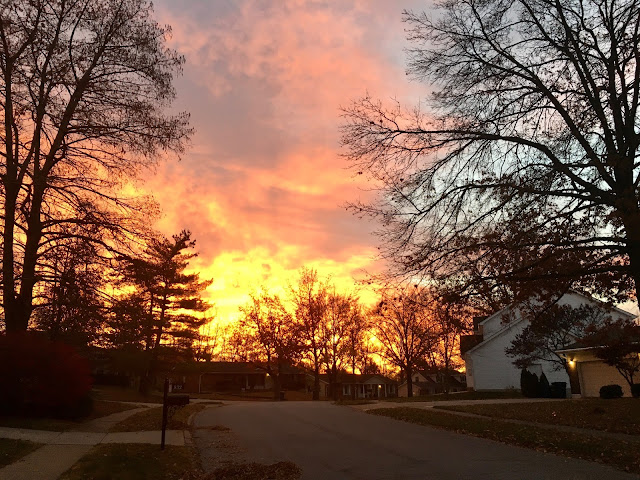
  Photos contributed by Mike Willock. (Good eye, Mike!)

My Ofrenda

Image
Mike Willock writes: Last week included, after Halloween (October 31), All Saints Day (November 1) and Dia de los Muertos (November 2). Dia de los Muertos (Day of the Dead) is a holiday in Mexico when families remember the relatives and friends that have gone before. They make an ofrenda (offering table) with pictures of lost relatives and items of food or other things that their relatives enjoyed in life. The Pixar movie Coco is a wonderful animated tale about a little boy Miguel and his old grandmother Mama Coco. If you haven’t seen it, you should. You can stream it on Disney. This week I have been thinking about the pictures and other items that would go on my ofrenda. I found slides of my paternal grandfather John and grandmother Verna, one with two of her brothers and their wives gathered around the family table with Barbara. I found a remembrance of the Celina, Texas, farmhouse written by my mother in the 1990’s. I found a picture of the old barn that was the subject...

Time traveling in a sermon

Mike Willock writes: In a recent sermon, Pastor Travis reflected on a mission trip in South Dakota where he and others built housing on an Indian reservation but never was able to meet the residents to talk with them and learn their stories. During the worship service, my mind traveled back to the late 1950’s and my grandfather’s farm in Celina, TX, a small farming community about 40 miles north of Dallas. There were no land acknowledgments then, but I have since learned that present-day Collin County was part of a buffer area shared by the Caddo, Cherokee, Delaware, Kickapoo and Tonkawa tribes. I remember rich, black farming land and rolling grazing land. Today Celina is slowly being absorbed into the sprawling Dallas-Fort Worth metroplex. For several summers in my early teens I traveled by train to spend a week with my Celina grandparents. The house was built on a hilltop and last painted in 1900, with a wraparound porch and swing. The porch ceilings were light blue and ther...

"You are not you when you are hungry"

Image
During Sunday's sermon, Rev. Travis referenced a classic commercial for Snickers, starring Betty White as a football player, or at least football player who "playing like Betty White." The ad, which is often mentioned as often of the most memorable ever made, ends with the tagline, "You are not you when you are hungry." The point - the astute theological point - that Travis was making was the Israelites wandering in exile, and lashing out at Moses, are collectively what we might now call "hangry" - grouchy, uncooperative, not their best selves. Perhaps Moses ought to have shown them this video to remind them that "you are not you when you are hungry." Here is a video of the ad, which you may not have thought about in years: You are not you when you are hungry

Paying Attention

Mike Willock writes: In a recent worship service, Pastor Travis challenged us to pay attention. He preached on the story of Moses, who first saw and turned aside from tending his sheep to approach the burning bush out of curiosity and then he met God there. In this modern era, with all the dings and screen prompts and calendar reminders competing for attention, we can easily miss or even dis miss signs of God’s presence in our lives.   I thought back more than 20 years to a Todd Hall workshop led by Rev. Belden Lane. He occasionally sat in the east transept at Second on a Sunday morning. Belden had us spend the hour after lunch looking for signs of God in nature. I found the first one close to the dining hall – a spray of flowers blooming in a decaying tree stump. Wandering farther afield, I only heard, but never saw, a deer moving through the brush a stone’s throw from the road. Two down, one to go, so I kept going farther on. Finally, walking back to the conference center alon...

Three-Word Prayers

Mike Willock writes: A recent Luther Seminary devotional highlighted two three-word prayers from the gospel of Matthew. I have added a third found in the Psalms. The first is in Matthew 14 after feeding the 5,000 when Jesus sent the disciples across the Sea of Galilee and went alone up the mountain to pray. Later that night the boat was caught in a storm and Jesus came to them walking on the water. Peter, ever the one to speak first, said, “Lord, if it is you, command me to come to you on the water.” When Jesus said, “Come”, Peter got out of the boat but soon he became afraid of the wind and waves and began to sink. He cried out “Lord, save me” (Matthew 14:30) and Jesus caught him by the hand and rescued him. That’s one. The second is from the Matthew 15 story of the Canaanite woman who pleaded with Jesus to heal her demon-tormented daughter, crying, “Lord, help me” (Matthew 15:24). Jesus praised her persistent faith and healed her daughter, which marked a turning point in Jesu...

The Glory of Summer

Image
  "To plant a garden is to believe in tomorrow" - Audrey Hepburn Crape myrtle in full bloom - photo submitted by Mike Willock

Thoughts on the Kingdom and the "Kin-dom"

Image
 Tim Woodcock writes:  It has been only been ten days since King Charles III was crowned. As a Brit, people have asked me about it multiple times since then. Do I like Charles? Am I a fan of the royal family? Does the pomp and circumstance of the occasion make me glow with pride? My thoughts and feelings on this are so complex and contradictory that trying to write a coherent response seems impossible. So instead here are some impressionist bullet points, firstly on the British royal family, and secondly on the idea of kingship plays in the modern church.          The verb is “crowned,” people! It is not as I heard it on a reputable news source, NPR, recently – “coronated.”           King Charles – not very inspiring, is he? I suppose you can say he will grow into the role and it’s simply impossible to please everyone as a monarch, especially as a monarch in the modern world. Queen Elizabeth II’s stature as a dignified, fai...

A Tale of Two Basins

Image
Mike Willock writes: Moving from the Maundy Thursday service in Niccolls Hall to the sanctuary where the Stations of the Cross are displayed, I was struck by two contrasting uses of a basin and water for washing. The basin in the Last Supper was used by Jesus, as described in John 13: “Jesus got up from the table and took off his robes. Picking up a linen towel he tied it around his waist. Then he poured water into a washbasin and began to wash the disciples’ feet, drying them with the towel he was wearing. … After he washed the disciples’ feet, he put on his robes and returned to his place at the table. … If I, your Lord and teacher, have washed your feet, you too must wash each other’s feet. I have given you an example: Just as I have done, you must also do. ... I give you a new commandment: Love each other. Just as I have loved you, so you must also love each other. This is how everyone will know that you are my disciples, when you love each other.” The other basin was used by Pon...

A Good Friday poem by Ellie Stock: "Relentless is Creation's Via Dolorosa"

Image
RELENTLESS IS CREATION’S VIA DOLOROSA   Relentless is Creation’s Via Dolorosa— choosing each millisecond along its ever expanding Tree-of-Life journey— emerging, purging, resurging, fragile resilience ever setting Being’s face toward new Jerusalems: galaxies swirling, atoms whirling, comets hurling, creatures toiling, humans turmoiling and gargoyling.   Relentless is Creation’s Via Dolorosa to temples of grandeur, upsetting tables of the greedy, setting up banquets with the needy, mocked, bound, beaten, crowned with corporate logos by those who wash their hands politely, litigiously while Pachamama’s precious vitality— sapped, tapped, stretched, plundered— pours black blood and fool’s gold, its seamless garment stripped, folded, and gambled for spoils, its parched sighs ignored while skies blacken, mountains shake, winds choke, seas roar, and fires scorch.   Relentless is the Cry of Creation’s Via Dolorosa— reverbera...

Labels

Show more